Decoding the Global Shifts in High-Speed Steel (HSS) and Cobalt Steel Tooling
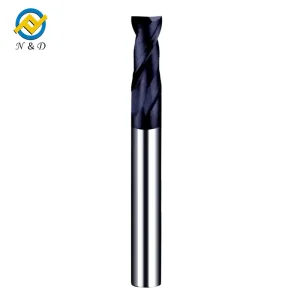
In the current era of "Industry 4.0," the demand for materials that can withstand extreme thermal loads without losing structural integrity is skyrocketing. Cobalt Steel End Mills, typically formulated with 5% to 8% Cobalt (M35 and M42 grades), represent the critical middle ground between traditional High-Speed Steel and Solid Carbide. As a primary Custom Cobalt Steel End Mills Factory, we recognize that our clients aren't just looking for tools—they are seeking "Material-Specific Advantage."
Global industrial trends indicate a massive shift toward "Difficult-to-Machine" (DTM) materials in aerospace and renewable energy sectors. Cobalt steel provides the necessary red-hardness—the ability to maintain a sharp cutting edge at temperatures exceeding 600°C. This makes it the premier choice for machining titanium alloys, Inconel, and high-tensile stainless steels where carbide might be too brittle due to vibration or machine tool limitations.
The global cutting tool market is projected to reach $25 billion by 2027. Our factory, established in 2004, has navigated the transition from local manufacturing to global export, now serving over 60 countries. We provide the stability that large-scale industrial buyers require: consistent hardness (HRC 66-70) and ISO-compliant geometries.
Operating out of Guanghan, China, we integrate local cost-efficiency with international quality standards (ASTM, DIN, and JIS). Our compliance framework ensures that every batch of Cobalt Steel is traceable, meeting the rigorous environmental and metallurgical standards required by European and North American distributors.
Whether it is for local automotive plants in the Midwest or aerospace workshops in Bavaria, our tools are tuned for local machine dynamics. We offer "Custom Quotes" that factor in regional material variations, ensuring the End Mill's helix angle and relief are optimized for your specific shop floor conditions.
Pushing the Boundaries of Metallurgical Engineering for 2025 and Beyond
Our R&D roadmap focuses on "Information Gain" in tool longevity. By 2025, we are integrating Nano-AlTiN Coatings with our Cobalt substrates to enhance oxidation resistance. Unlike standard mills, our future generations will feature variable helix designs to suppress harmonic vibrations during high-speed machining (HSM).
How We Ensure the Highest Quality Cobalt Steel End Mills

Precise mixing of tungsten carbide, cobalt, and rare metals in aviation gasoline to ensure molecular homogeneity.

Transforming the mixture into a ready-to-press powder through controlled thermal extraction of the liquid medium.

High-pressure molding to form the initial "green" geometry of the tungsten carbide and cobalt blank.

Heating to extreme temperatures under pressure to eliminate porosity and maximize material density.

Advanced ANCA or WALTER machines cut the intricate flute and relief angles with sub-micron accuracy.

Comprehensive metallurgical and dimensional audits using Zoller Genius inspection systems.

Founded in 2004, our company is a leading manufacturer of tungsten carbide products, specializing in the production of high-quality carbide materials. Headquartered in Guanghan, Sichuan Province, China, we have become an industry leader, serving a wide range of industries including mining, construction, oil and gas, and manufacturing.
Our team consists of 120+ dedicated professionals who are well-versed in the intricacies of metallurgical engineering. Through continued investment in research and development, we strive to be at the forefront of technological advancement, allowing us to provide our customers with cutting-edge solutions that reduce downtime and maximize machining efficiency.
Expert answers to the most common questions about Cobalt Steel End Mills
M35 contains 5% Cobalt, while M42 contains 8%. M42 is harder and offers better heat resistance (red-hardness), making it superior for stainless steel and superalloys. M35 is tougher and better for interrupted cuts.
Choose Cobalt steel when your machine setup isn't perfectly rigid or when you face vibration issues. Cobalt is more "forgiving" than brittle carbide and is more cost-effective for smaller batch sizes or maintenance jobs.
Yes. As a production-oriented factory, we specialize in OEM/ODM services. We can adjust flute count, helix angle, and coating based on your specific application (e.g., slotting vs. profiling).
Simply provide us with your technical drawing or tool specs (diameter, length of cut, shank size, and material grade). Our engineering team typically provides a quote within 24 hours.
Absolutely. Our tools are ground on 5-axis CNC machines and feature h6 shank tolerances, ensuring high compatibility with shrink-fit, hydraulic, and ER collet chucks.
Depending on the material, our Cobalt Steel End Mills typically offer 3x the life of standard HSS tools when machining abrasive materials like cast iron or work-hardening stainless steel.
Our engineers are standing by to optimize your tooling strategy.
Get a Factory Quote N&D Carbide